

You’ve found an EMDR therapist you’d like to work with, but they only offer online appointments. Can EMDR be done virtually? You can picture joining a video call, but the exercises are harder to imagine. Where do you look during guided eye movements? What happens if the screen freezes halfway through?
Those questions are worth asking before you book. This guide walks you through a virtual EMDR session, including how therapists guide eye movements or tapping over video. You’ll also see what studies say about online versus in-person care and what to consider when choosing between them.
Key Takeaways
- A 2026 trial found video EMDR cut earthquake survivors’ average PTSD scores, 62.7 to 34.2.
- In-person EMDR eased PTSD more than telehealth in VA data, d = 0.85 versus 0.66.
- A VA review of 279 veterans found similar EMDR completion in person and by telehealth.
- Web and face-to-face EMDR differed only on worry in 65 people with generalized anxiety.
- Weak Cardiff evidence links online EMDR to lower PTSD scores among finishers, 17.1 versus 24.5.
- A 2024 review of 16 articles called remote or self-administered EMDR promising for PTSD.
- EMDRIA advises consenting to a technology failure or crisis plan before virtual EMDR.
- For virtual EMDR, EMDRIA recommends a computer or larger tablet over a phone.
- Virtual EMDR clinicians should use video tools with a HIPAA business associate agreement, EMDRIA says.
Can EMDR Be Done Virtually?
Yes. EMDR can be done over secure video when a trained clinician leads it live. The EMDR International Association (EMDRIA) defines virtual EMDR as therapy that an EMDR-trained clinician delivers online.
The key word is clinician. EMDRIA’s definition leaves out websites, apps and companies that offer EMDR self-therapy without live guidance. A program that runs on its own does not count.
So the real test is not the screen. It is whether a trained person is guiding you in real time.
Why the Question Stayed Open
Professional bodies outside the US have also addressed a practical question for clinicians. Under what conditions can EMDR be done virtually? A recent systematic review notes that EMDR Europe, the EMDR Association UK and EMDRIA have each issued guidelines for online EMDR. They cover security, therapeutic considerations and which clients suit remote work.
Guidelines tell clinicians how to practice. They do not show that the practice works. When EMDRIA’s task group reported in January 2020, clinicians were only starting to move into telehealth. The group found no research to support or refute virtual EMDR.
Does Virtual EMDR Work as Well as In-Person EMDR?
What the Earthquake Trial Found
The evidence has moved fast since that 2020 report. A 2026 randomized trial in Frontiers in Psychiatry gave 89 adult earthquake survivors in Türkiye 12 weekly video sessions of EMDR, trauma-focused CBT or a wait-list. Both therapies cut PTSD scores while the wait-list group barely changed.
Average PCL-5 scores in the EMDR group fell from 62.7 to 34.2. The CBT group fell from 61.2 to 38.6. The wait-list group stayed near 59. The authors cite 33 as the cutoff for probable PTSD. So the EMDR average finished just above it.
Read that as a group average, not a cure. One therapist delivered all the EMDR. The trial wasn’t built to rank EMDR against CBT. And it has no long-term follow-up yet.
What the Veterans Data Show
Can EMDR be done virtually as well as in-person care? Answering that takes a direct comparison between the two formats. The main US data come from the Department of Veterans Affairs. A multisite chart review of 279 veterans compared 139 people treated in person with 140 treated by telehealth.
On most measures, the two groups looked alike. Treatment completion did not differ. Neither did reliable or clinically significant change in PTSD and depression symptoms. One gap did show up. After adjusting for other factors, the in-person group improved more on PTSD symptoms (d = 0.85 against 0.66). A higher d means a bigger change.
Both groups improved, and the authors called the outcomes largely similar. Patients also weren’t assigned to a format by chance, because this was a chart review. So the fair reading is a possible edge for in-person care. It is not a failure of telehealth.
What the Welsh Evaluation Found
A Welsh health service evaluation at a traumatic stress service in Cardiff asked the same question on a smaller scale. It compared 45 people who had EMDR online with 33 who had it in person the year before. Among those who finished treatment, online patients ended with lower PTSD scores (17.1 against 24.5).
That sounds like a win for online care. The statistics say to slow down. The gap fell just short of statistical reliability (p = .06), and the authors called it weak evidence. The groups weren’t randomized. Only completers were analyzed, which can bias results. Completion, dropout and adverse events looked similar in both formats.
Interviews with 11 patients and five therapists added what the scores cannot. Clients said they liked feeling in control and skipping travel. They worried about privacy and the lack of a gap between therapy and daily life.
What the Anxiety Trial Adds
A randomized trial of 65 people with generalized anxiety in Iran adds a different angle. Participants were randomly assigned to ten sessions of face-to-face EMDR, ten sessions of web-based EMDR or a wait-list. Both EMDR formats beat the wait-list by a wide margin. The gains held at one and three months.
The authors found no significant difference between the two formats, except on worry. This trial has limits too. Anxiety is not PTSD. And a wait-list shows that treatment helps. It cannot show that EMDR itself does the work.
Each of these studies is small or imperfect. Still, none of the three found that virtual EMDR failed. A wider review shows whether that pattern holds.
What the Evidence Adds Up To
A 2024 systematic review gathered 16 articles with 1,231 participants. Some tested live remote sessions. Others tested self-administered computer programs. The reviewers called the results promising for PTSD symptoms, anxiety and depression. They also flagged small samples, missing control groups and reliance on self-report.
So, is virtual EMDR effective for PTSD symptoms? The studies reviewed suggest it can help reduce them. Whether it matches in-person care is still open. In veterans, in-person did a little better. Elsewhere the gaps were small or unclear.
Remote EMDR looks like a reasonable option. The research hasn’t yet shown it’s an equal one. Treat that as a fair question for any clinician. A good one will name what the data can and cannot promise.
What Happens During a Virtual EMDR Session?
The structure of EMDR stays the same online. It follows eight phases: history taking, preparation, assessment, desensitization, installation, body scan, closure and re-evaluation.
Early sessions cover history taking and preparation. You and your therapist talk through what you want to work on. You also use resourcing in EMDR to build calming skills before working through difficult memories. EMDRIA notes that some phases feel like any other video meeting.
How Reprocessing Works Online
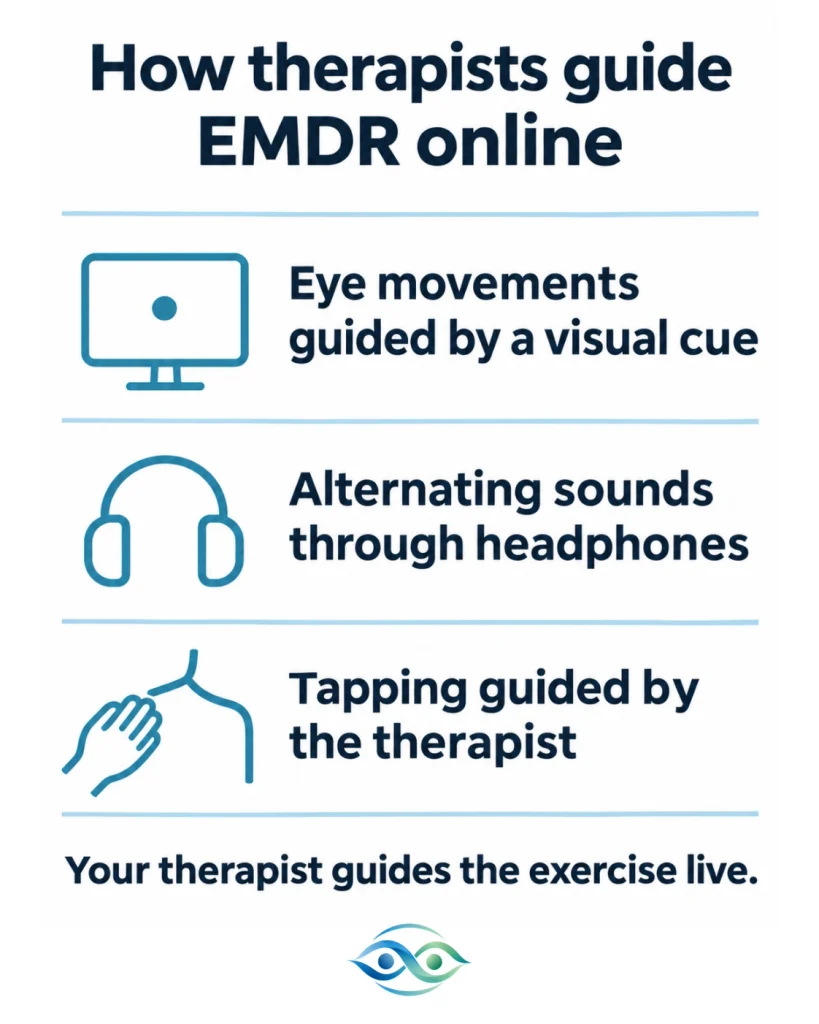
Reprocessing is where online EMDR looks different. Your therapist explains how to do EMDR remotely and guides you through short sets of bilateral stimulation. Then they check in and adjust the pace.
EMDRIA lists several ways to do this online. You might follow a graphic on screen with your eyes. You might hear alternating tones in headphones. Or you might tap your own shoulders under guidance, as in the butterfly hug.
The earlier Türkiye trial used on-screen tracking and client tapping. If one method feels wrong, say so. You can stop at any time.
Closing the Session at Home
Every session ends with closure. Your therapist helps you settle and checks how you feel. At home, no commute separates therapy from the rest of your day.
EMDRIA notes that many clients feel tired afterward. It suggests leaving buffer time instead of booking something demanding. When you plan your day, check how long an EMDR session lasts and leave some time free afterward. Whether the format suits you depends on more than your calendar.

Virtual vs. In-Person EMDR: Which Format Fits You?
How the Two Formats Compare
The protocol is the same. The day-to-day experience is not. Think about the first ten minutes of a session.
In an office, the room sets the mood for you. At home, you set it yourself. The table shows the main differences.
| What to Compare | Virtual EMDR | In-Person EMDR |
| Travel and access | No commute. More clinicians to choose from, if they are licensed where you sit. | Travel time. Local clinicians only. |
| Control over the space | Your own room. You manage privacy and interruptions. | An office set up for therapy. |
| Reliance on technology | Camera, audio and connection must hold. | Little technology involved. |
| How the therapist observes you | Face and upper body on screen. | Whole body in the room. |
When Virtual EMDR Fits Well
Virtual care fits well when travel is the barrier. EMDRIA lists fewer office distractions and no commute among the benefits.
It singles out people with chronic illness, mobility limits or childcare needs. For them, the format can decide whether therapy happens at all. Those benefits only hold if the setup works, though.
When In-Person or Hybrid Care Fits Better
Some situations call for in-person or hybrid care. Privacy is the first one. EMDRIA advises clients to find a quiet, comfortable and private space, because sessions can bring up intense emotions. That is hard to do in a shared home where you can’t close a door. Headphones can keep the conversation private. They can’t stop someone from walking in.
Connection is the second. EMDRIA calls a stable connection essential for a smooth session. A dropped call in an ordinary meeting is an annoyance. Partway through a painful memory, it is more than that. If your connection fails often, an office removes that risk.
If you are unsure, raise a hybrid plan with your therapist. Starting in person and moving online later is one option.
When Home Doesn’t Feel Safe
Your home itself can also get in the way. A room can be private and still not feel safe. For some people, home is not a place where hard feelings can safely come up.
A room tied to the memories you are working on can make reprocessing harder. So can a household where you don’t feel safe. An office gives you neutral ground, and you leave it when the session ends. Tell your therapist if either sounds familiar.
How to Get Started With Online EMDR Therapy
Find a Licensed Provider
Start with the provider. Look for an EMDR-trained clinician with remote experience.
Then check licensure. Your therapist must be licensed to treat you in the state where you sit during the session, even online. The PSYPACT compact helps some psychologists cross state lines. EMDRIA’s report says it covers licensed psychologists only. Other license types follow their own state rules. Confirm which apply to your therapist.
Insurance rules for telehealth also differ by state and insurer. Check with yours before the first visit. Ask your therapist about EMDR session costs so you can use the fee and your coverage details to estimate what you’ll pay out of pocket.
Prepare Your Space and Device
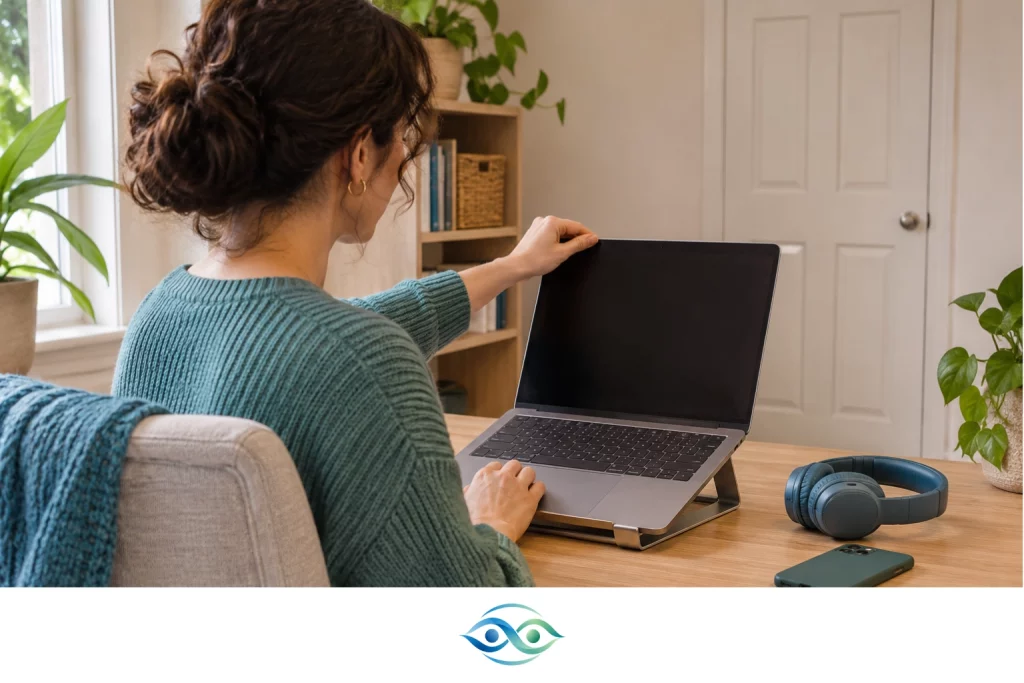
Next, set up your space. Choose a time that allows for privacy and minimizes interruptions. Silence your notifications and tell the people at home you are in a session. Then test your camera, microphone and connection. EMDRIA suggests an Ethernet cord if you can use one.
Can EMDR be done virtually on a phone? EMDRIA recommends a computer or larger tablet because a bigger screen gives your eyes more room to travel. Some therapists use a separate platform built for stimulation. Check which device and which windows you will need.
Then look at the video platform itself. HHS says the HIPAA Rules generally require a business associate agreement with vendors that handle protected health information for a provider. EMDRIA tells clinicians to choose video tools that carry one. So confirm that your therapist’s platform does.
Agree on a Backup Plan
Finally, agree on a backup plan. Settle how you signal a pause. Settle who calls whom if the video drops. EMDRIA’s guidelines say clinician and client should consent to a plan for technology failure or crisis before therapy begins.
They also tell clinicians to collect emergency contacts for your area, because 911 in the therapist’s region can’t respond to a crisis elsewhere. So tell your therapist where you are sitting each session. Name an emergency contact.
Now picture it. Your video freezes mid-reprocessing. You pause. Your therapist calls the number you agreed on. Both of you follow the plan.
Conclusion
Can EMDR be done virtually? Yes, and what makes it workable is often practical. You need a place where you can speak freely, a reliable connection, and a therapist experienced in guiding sessions online. The research on virtual EMDR is encouraging, though it’s still unclear whether it works as well as in-person care.
If you’re leaning toward online sessions, talk with your therapist about how to prepare for your first EMDR session. Ask how you’ll pause if you need to and what happens if the call drops. Those details can help you and your therapist decide whether starting online feels right for you.