

You’ve booked your first EMDR appointment, and now you’re wondering how to prepare for EMDR. The confirmation email tells you when to show up, but it leaves you guessing about what happens once you arrive. Will the therapist ask why you came in, or will you start working on a memory right away? And how much of your story will you be expected to tell?
Those questions are easier to sort through when you know what the first visit is for. This guide walks you through what to expect and what you might want to ask your therapist. It also includes a short worksheet you can use if you’d rather gather your thoughts on paper.
Key Takeaways
- EMDRIA says most clients need one to four sessions to prepare for EMDR reprocessing.
- EMDRIA recommends working with a fully trained EMDR therapist.
- EMDR history taking and treatment planning usually takes one to two sessions, EMDRIA says.
- A general outline of distressing memories is enough to start EMDR, EMDRIA says.
- The US VA puts EMDR sessions at 50 to 90 minutes.
- An NHS talking therapies service advises having supportive family or friends during EMDR.
- EMDRIA encourages calming techniques and a journal between EMDR sessions.
- An NHS talking therapies service typically gives 12 to 16 EMDR sessions for non-complex PTSD.
How to Prepare for EMDR
You do not need to be ready to talk about everything. Attend as you are. A rough idea of what brought you to therapy is enough, and nothing at all is fine too.
Some preparation may still help. Note one concern and one hope. Plan the visit and bring your questions. Your therapist teaches coping skills before any reprocessing starts, because recalling a distressing memory can stir strong feelings.
If you’re wondering how long EMDR therapy takes, start by asking your therapist how often you’ll meet. Sessions are usually weekly. The US Department of Veterans Affairs puts a typical course at about three months, with sessions lasting 50 to 90 minutes. An NHS talking therapies service gives 12 to 16 sessions for non-complex PTSD, face to face or by video.
EMDRIA recommends working with a fully trained EMDR therapist. If you’re still choosing a therapist, ask about their EMDR training before you book. Once you’ve booked, ask how to prepare for EMDR and what to expect at your first appointment.
Next, get to know your stress signals. Notice where stress lands in your body. For some people it is a tight jaw or a heavy chest. For others it is shallow breathing. During EMDR you notice thoughts, feelings and body sensations, so this is useful practice.
Finally, put it on paper. An EMDR preparation worksheet turns your concern, your hope and your stress signals into words you can hand to your therapist.
EMDR Preparation Worksheet for Your First Appointment
A worksheet gives you words before the appointment starts. It is optional. Skip any question you don’t like. Your notes stay private unless you share them, or you can bring them as conversation starters.
| Question | Your notes |
| What is getting in the way of daily life right now? | |
| What would I like to be different? | |
| How does overwhelm show up in my body? What place, person or activity steadies me, real or imagined? | |
| What has helped or felt unhelpful in past therapy? | |
| What would I like to ask before we start? For example: What are we focusing on today? How will we decide when to start on a memory? Which bilateral stimulation will we use? |
One entry might read like this. After a car crash, you avoid a familiar route. You would like to drive it again.
There is no trauma timeline or distress rating here. Those belong to history taking and assessment, which EMDRIA lists as phases you work through with your therapist. Once your notes are done, the day itself needs only a little planning.
How to Prepare for Your First EMDR Session: Practical Steps
Before your first EMDR appointment, complete any intake forms and confirm where you’ll meet. If you’d prefer to meet by video, ask whether you can do EMDR virtually throughout treatment, including sessions that use eye movements, taps, or tones. Once you have a video appointment booked, test the link and find a private place where you can speak freely.
Then look after the basics. Eat something light and drink water. Wear clothes that feel comfortable. Sleep if you can. In person, bring something grounding to hold, such as a smooth stone. Tell your therapist which medication you take and ask what to avoid before sessions. Do not change a prescription without your prescriber.
Leave a short buffer afterward if your schedule allows. Treat it as a scheduling choice. A free stretch after the visit is easier to arrange than a rushed switch to your next task.
What Happens at Your First EMDR Appointment
Discuss What Brought You to Therapy
Your worksheet becomes the opening of the conversation. The therapist asks about current difficulties, relevant history, past treatment and the support you have. This is history taking and treatment planning. EMDRIA, the professional body for EMDR therapists, says it usually takes one to two sessions.
The answers show whether EMDR fits and what your goals are. You can start broad. EMDRIA says a general outline of distressing memories is enough. Share only what feels manageable.

First Appointment vs First Reprocessing Session
You might expect eye movements at your first EMDR appointment. They usually come later, after you and your therapist have had time to prepare. Here’s how those early visits typically differ.
| Visit | What happens | Bilateral stimulation |
| First appointment | History taking, treatment planning and your questions | Usually none |
| Preparation visits | An explanation of the method, coping skills and a pause signal | Trial only |
| First reprocessing session | Work on a chosen memory once you and your therapist agree you are ready | Yes |
Timing differs from person to person. EMDRIA stresses that speed is not the goal. Some clients spend weeks on preparation. Others move quickly.
How to Prepare for EMDR Therapy: What Your Therapist Covers First
Practice Ways to Manage Distress
Phase 2 is the formal preparation phase. Your therapist shows you how to prepare for EMDR therapy by practicing ways to manage distress. You learn how EMDR works and how to settle yourself when feelings rise. A simple skill is noticing your feet on the floor. It pulls your attention back to the room.
Your therapist may also introduce resourcing in EMDR, which involves building on what helps you feel steadier. Two exercises you might try during preparation are the calm place and the container. In a calm place exercise, you picture somewhere steady. In a container exercise, you picture storing distress until the next visit. If no calm place comes to mind, say so. A real or imagined place works. Say when an exercise does not help. Your therapist can try another.
Your therapist may also test bilateral stimulation. That means eye movements, alternating taps or tones. EMDRIA places this trial in preparation. Reprocessing itself is not something to practice at home.
Choose a Pause Signal and Say How Ready You Feel
Before reprocessing starts, you choose how to stop it. Pick a word or a gesture. Raising a hand is common. Try it once in the room so it feels normal to use.
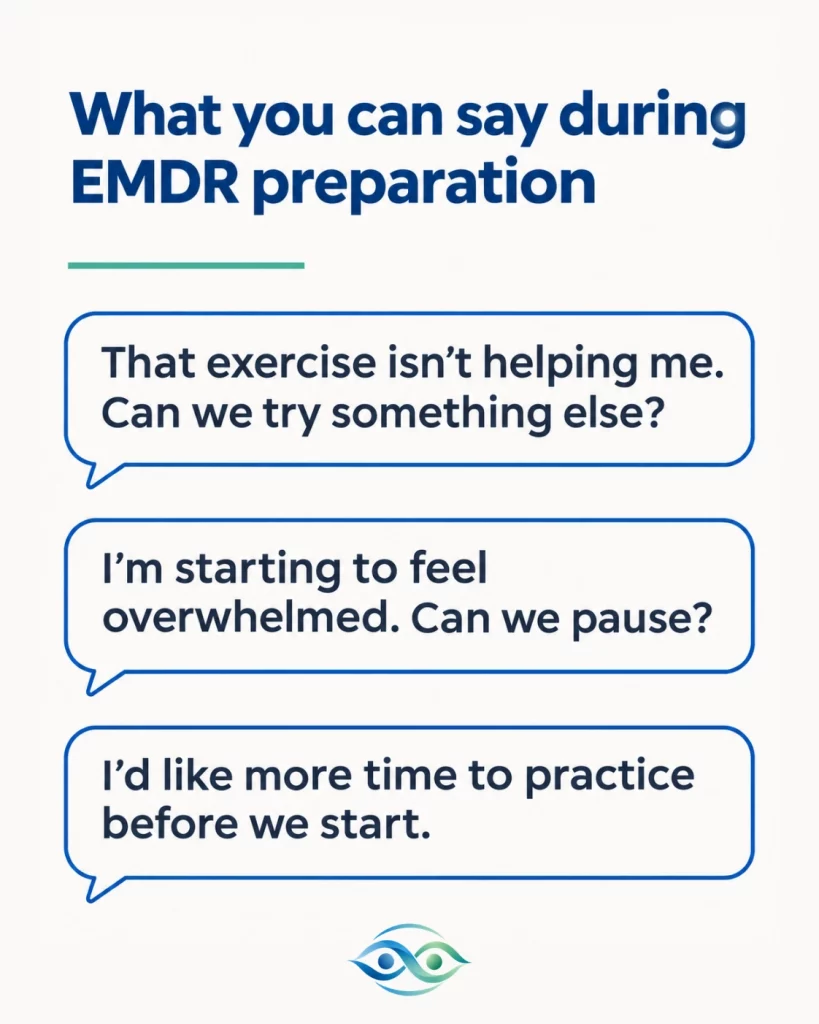
Your therapist will also ask how you handle distress, what helps you settle and whether you feel ready to go on. Answer as honestly as you can. EMDRIA says most clients need one to four preparation sessions. People with severe trauma histories or certain diagnoses may need longer. Needing more time is a normal outcome. These lines can help you say what you notice.
| What you notice | What to tell your therapist |
| Nothing comes to mind for a calm place | Nothing comes to mind. Can we try something else? |
| Feelings rise fast | I feel flooded. I need to slow down. |
| You are unsure about starting | I am not ready yet. I want more practice first. |
Make a Plan for Between Sessions
The container exercise earns its place between visits. Processing can continue after a session, and new material can surface. EMDRIA encourages calming techniques outside therapy and keeping a journal.
Before you leave, agree on three things.
- Which strategy you will use if distress comes up.
- How and when to contact your therapist, including any support outside appointment hours.
- What you will bring to the next visit, such as a skill that helped or felt hard to use.
An NHS talking therapies service also advises having family or friends you can lean on, because the process can be upsetting. If distress becomes severe, contact your therapist or your local emergency number or crisis line.
Frequently Asked Questions
Can I prepare for EMDR if I have gaps in my memory?
Yes. You do not need a full memory of what happened. Tell your therapist about the gaps at the first visit. Preparation focuses on coping skills, not on filling in what is missing.
What should I tell my therapist if I tend to go blank when I’m stressed?
Say it plainly. For example: I go blank when I am stressed, and I may not notice it happening. Ask how your therapist will check in with you during sessions.
Choose your pause signal with that in mind. A gesture can be easier than a word when words are hard to find.
Should I tell my regular therapist if I’m starting EMDR with someone else?
Yes, if you are comfortable. EMDR can run alongside other therapy. Your regular therapist can help you settle between visits and avoid working at cross purposes.
You choose what to share. If you want the two therapists to talk, your EMDR therapist will explain the consent form first.
Will I need to repeat EMDR preparation if I switch therapists?
Some of it, yes. A new therapist needs their own history taking and treatment plan. They also check your readiness themselves. Bring your notes and the coping skills that worked.
Conclusion
If you’re wondering how to prepare for EMDR, start with what you’d like your therapist to know. That could be something you want to change or a concern about how you’ll feel during the session. A few notes can help you find the words, and you can share them at your own pace.
The first appointment gives you a chance to ask questions and talk about what helps when you feel overwhelmed. From there, you and your therapist can practice ways to manage distress and decide when to begin reprocessing. If you need more time, that’s something you can say out loud.