

You can know a danger has passed and still feel your chest tighten. A reminder appears, and the body reacts before the mind catches up. So what is the AIP model in EMDR, and how does it explain a reaction like that? AIP stands for adaptive information processing, the framework Francine Shapiro developed to guide EMDR therapy.
The idea underneath is simple: the mind links new experience to what it already holds. The model proposes that this linking can fail when an experience overwhelms the system. Below, we’ll break down how the model works, what makes a memory unprocessed, and what reprocessing means. You’ll also see what research has established and where questions remain open.
Key Takeaways
- VA/DoD’s 2023 guideline recommends EMDR as one of three manual-based, trauma-focused PTSD psychotherapies.
- Rydberg’s 2024 review identified seven models that complement the AIP model in EMDR.
- WHO guidance says EMDR does not involve detailed descriptions of traumatic events.
- Landin-Romero’s 2018 review of 87 studies found reasonable support for EMDR’s working memory account.
What Is the AIP Model in EMDR?
The AIP model is the Adaptive Information Processing model, the theoretical framework behind EMDR therapy. Francine Shapiro developed it. The model guides clinical practice, explains how psychological difficulties develop and predicts EMDR treatment effects.
How the AIP Model, AIP System and EMDR Therapy Differ
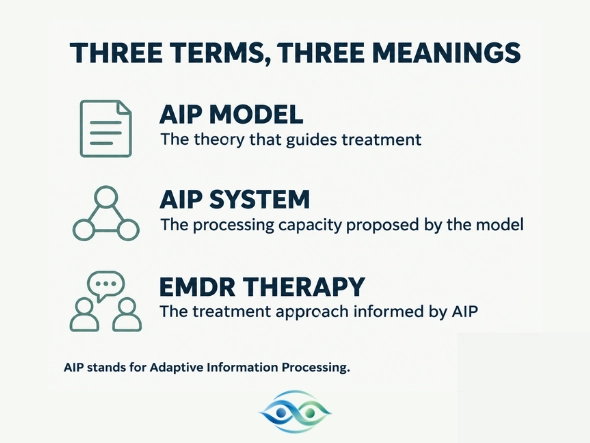
The AIP model is the explanation that guides treatment. The AIP system in EMDR is the capacity the model proposes people have to process and integrate experience. EMDR therapy is the treatment informed by the model. The system is the proposed mechanism, the model is the theory about it and the therapy is the practice built on that theory.
Working Hypothesis and Scope
The AIP model grew out of observations Shapiro made about how people changed during treatment in the early development of EMDR. She presented the model as a working hypothesis. Its central premise is that a disturbing memory can be stored without being processed.
The model also covers positive, adaptive information. Posttraumatic stress disorder (PTSD) is the usual example, but the model proposes that disturbing experiences sit behind a wider range of difficulties.
Underneath sits one idea: the mind connects new experience to what it already holds.
How Does Adaptive Information Processing Work?
Adaptive information processing is the information processing model of EMDR therapy. It describes how the mind takes in an experience, connects it to what it already knows and keeps what it learned.
The model calls stored knowledge memory networks. A memory network is a group of linked memories, together with the thoughts, images, emotions and sensations that belong to them.
Learning From New Experience
When something new happens, the system links it into the networks it relates to. A child who wobbles on a bike connects the wobble to what they know about balance and speed. Next time, the child brakes earlier. The model holds that the mind usually handles stressful experiences the same way, processing it to complete integration.
Adaptive Information and the Healing Comparison
Adaptive means useful and realistic. Adaptive information is learning that fits the facts and helps a person act well. Supportive experiences and existing strengths count as adaptive information too, because they give a new experience more to connect with. EMDR clinicians often call this kind of material a resource. During resourcing in EMDR, a therapist might help a client recall a time they felt supported so they can draw on that memory during treatment.
Shapiro compared the system to the body, which is geared physiologically to heal when injured. The model treats mental processing the same way: it runs on its own unless something interferes. But what is the AIP model in EMDR proposing when an experience is too large to connect?
What Is an Unprocessed Memory in EMDR?
The model proposes that processing can fail when an experience overwhelms the system. Proposed interferences include intense emotion, exhaustion, drugs and the absence of an attachment figure, a list laid out in a 2017 paper by Michael Hase and colleagues.
The memory can then be stored in a raw, unprocessed form. A distressing incident may be stored in state-specific form, unable to connect with the networks that hold adaptive information.
The model describes such memories as dysfunctionally stored. Clinicians often call them stuck or frozen in time. Both phrases are explanatory shorthand.
What Makes a Memory Unprocessed
Unprocessed means more than avoiding thoughts about an event: a person can discuss it freely while the memory stays unlinked from newer knowledge. The model describes four channels in a stored memory: images and recollections, negative beliefs about the self, emotions and physical sensations.
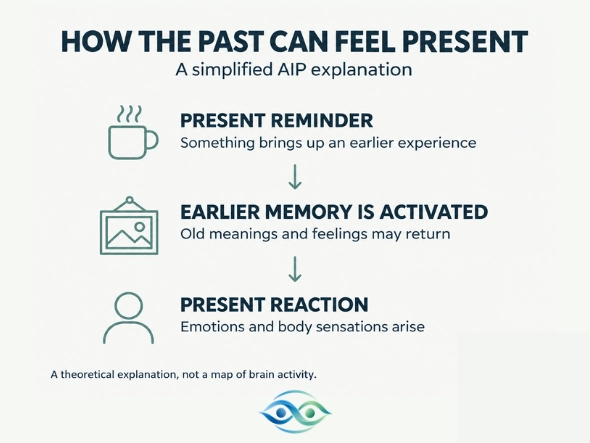
A memory stored this way keeps its original emotions, sensations and beliefs. Present reminders pull on that material, so the past becomes present. That accounts for a familiar gap: a person can know something intellectually and still feel otherwise.
Small-t and Large-T Experiences
Large-T traumas are major events, and small-t traumas are ordinary adverse ones such as teasing or criticism. Both can go unprocessed. Shapiro’s 2014 review in The Permanente Journal notes that general life experiences can produce more posttraumatic stress symptoms than major trauma. A hypothetical childhood humiliation in front of a class is one.
What Does Reprocessing Mean in EMDR Therapy?
Reprocessing is the model’s proposed route from an unprocessed memory to an adaptive resolution. The idea is that the distressing memory links up with adaptive information it was cut off from. Once the information is reprocessed, the AIP system in EMDR relinks and a more positive understanding of the present can emerge.
Adaptive information is concrete. It can be present safety, where the danger has passed, an accurate sense of responsibility for the event, or current choices, abilities and support.
Conditions for Linking and the Role of Bilateral Stimulation
The model sets one condition. Adaptive memory networks need to be present and accessible, and the therapeutic relationship counts as part of them. Shapiro took that position in 2001 and again with Deany Laliotis in 2017.
The model proposes that bilateral stimulation, such as eye movements, taps or tones, activates the processing system. What follows is a shift in the memory’s meaning, emotional charge and bodily reactions.
Integration Without Forced Positive Thinking
Integration differs from forced positive thinking. The adaptive information comes from the person’s own networks, so reprocessing links what is already there instead of arguing a new belief into place.
The event is still remembered. An adaptive resolution means recalling it without re-experiencing the old emotions or sensations. That is the model’s aim, not a guaranteed outcome or an erased memory.
So what does that chain look like applied to one case?
The EMDR AIP Model Explained Through an Example
Consider a hypothetical adult who was humiliated in front of a class as a child and now feels distress when giving presentations. This is a small-t example, an ordinary adverse event rather than a major trauma.
In the model’s terms, the classroom moment is the earlier experience and the upcoming presentation is the present reminder. The reminder links to the stored material, so the adult feels an old negative cognition, a belief about the self, along with shame and a physical reaction.
The adult’s present abilities and support are adaptive information the old moment never connected with.

Possible Changes After Reprocessing
| Aspect | Before reprocessing | Possible change after reprocessing |
| Image or recollection | A vivid recollection of the classroom moment | The recollection remains, held with less charge |
| Belief about self | A belief of being incapable or exposed | A belief that fits the adult’s actual abilities |
| Emotion | Shame and dread before presenting | Nervousness that matches the situation |
| Body sensation | A tight chest and a shaky voice | Less bodily alarm in presenting settings |
How Does the AIP Model Guide EMDR Treatment?
Beyond explaining why symptoms arise, the AIP model organizes how clinicians plan treatment.

Connecting Past Experiences, Present Triggers and Future Responses
Clinicians use the model for case conceptualization, also called case formulation: a working picture of how a person’s difficulties fit together. The model points the clinician to the whole clinical picture, including the past experiences behind current difficulties.
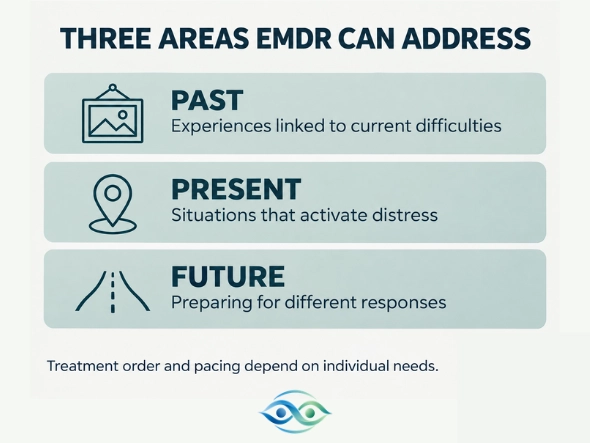
That picture yields three treatment targets, called prongs. The first is past experiences contributing to current difficulties, such as the classroom moment. Next come present situations that activate distress, such as an upcoming presentation. Last are future situations that call for a different response, such as presenting with steadier confidence.
The prongs are what treatment aims at. The eight-phase protocol is the procedure that aims at them. Targets come from the case formulation, and not every memory becomes one.
Clinician and client build the formulation together. Sketching it as a diagram lets the client see how an old moment, a present trigger and a current reaction connect. It also gives both people a shared reference when planning treatment.
Considering Resources and Readiness
Before a memory is targeted, what is the AIP model in EMDR asking for? A check on whether adaptive information is available to link with. The first phase of the protocol includes that check, along with identifying the client’s strengths and judging whether the timing is right.
The therapeutic relationship is one source of that information. Pacing is individual, since some clients need a lengthy preparation phase, and assessment continues through reevaluation. The time spent in preparation is one factor in how long EMDR therapy takes overall.
What Does Research Establish About the AIP Model?
Evidence for EMDR’s outcomes and evidence for the AIP model’s explanation are separate questions. The 2023 clinical practice guideline from the US Departments of Veterans Affairs and Defense recommends EMDR for PTSD as one of three individual, manual-based trauma-focused psychotherapies.
Improvement after treatment cannot establish every model assumption, because different mechanisms could produce it.
AIP Theory as a Working Model
A 2024 narrative review in Frontiers in Psychiatry by Jenny Ann Rydberg and colleagues describes AIP theory as a working model formed from clinical observation before much neurobiological data existed.
This article names no brain regions, and the reason comes down to one term. When Shapiro wrote about a neural network, she meant the way one memory is set up in the brain. The phrase describes how a memory is organized, not where in the brain it sits.
Complementary Models and the Working Memory Account
Rydberg and colleagues identified seven complementary models to AIP theory. Five refer to predictive processing, the idea that the mind forecasts experience and updates those forecasts.
Some use reconsolidation, the idea that a recalled memory is stored again, possibly changed. Most treat associative processing, which links memories, and predictive processing as compatible, though several leave conflicts unexamined. These models are rarely cited in other EMDR literature.
A separate account concerns working memory, the mind’s short-term workspace, and how the dual task of recalling a memory while following eye movements or taps works. A 2018 systematic review of 87 studies by Ramon Landin-Romero and colleagues found reasonable empirical support for it and called mechanism research still in its infancy.
Open Questions
No model yet explains why similar experiences and comparable backgrounds lead one person to develop PTSD and another not. Trauma still lacks a precise definition, and the models divide on whether memories are static.
Frequently Asked Questions
Why Is AIP Sometimes Called Accelerated Information Processing?
The model was first called Accelerated Information Processing and was renamed Adaptive Information Processing in 1995. Older sources still use the earlier name. The new name reflects the model’s central claim that the mind processes experience toward an adaptive resolution.
Does AIP Require Detailed Recall of the Event?
The model works on a memory’s components, not on a full narrative. Shapiro’s 2014 review quotes World Health Organization guidance that EMDR does not involve detailed descriptions of the event. The EMDR International Association’s definition of EMDR adds that clinicians may postpone a detailed trauma history in complex cases.
Does AIP Treatment Always Start With the Earliest Memory?
Not necessarily. The same definition says clinicians identify targets from the presenting issue, drawing on negative life events. It also says the order of the three prongs can change, or a prong can be omitted, based on clinical judgment.
How Does AIP Explain Different Reactions to Similar Events?
Strengths and supportive experiences give a new experience more adaptive information to connect with. Hase and colleagues add that an absent attachment figure can impair processing. Rydberg and colleagues say no model yet explains why similar experiences lead to different outcomes.
How Is AIP Different From the Working Memory Explanation?
The AIP model addresses how difficulties develop and how change occurs. The working memory account addresses how the dual task works. Landin-Romero and colleagues describe it as a model in which eye movements tax working memory and reduce the memory’s vividness and emotional charge. The working memory account informs EMDR 2.0, which places more emphasis on making the task more demanding while the client recalls the memory.
Conclusion
What is the AIP model in EMDR, then? It is an explanation of why an old moment can still shape a present reaction. The model traces that reaction to a memory that was never linked with newer knowledge. It also gives clinicians a framework for choosing targets and judging readiness.
A 2023 VA and Defense guideline recommends EMDR for PTSD, but the model remains a working hypothesis. Researchers continue to test it, and no model yet explains why similar events affect people differently. Used as a guide, the model describes why the past can feel present and how treatment targets that.