

According to Francine Shapiro, the history of EMDR began with a walk in a park in 1987. Shapiro, who started out in English literature, noticed her upsetting thoughts fading. She linked it to the way her eyes were moving. That small observation grew into a therapy that WHO, NICE and VA/DoD now name in their PTSD guidelines.
Getting from that park to those guidelines took decades of testing and debate. Researchers still disagree about where the idea came from and why it works. In this article, you’ll follow EMDR from Shapiro’s first study in 1989 to today’s research. You’ll also see which parts of the story are documented and which are still contested.
Key Takeaways
- Shapiro’s 1989 EMD study of 22 volunteers reported lower distress through three-month follow-up.
- The 2023 VA/DoD guideline recommends EMDR as one of three individual trauma-focused PTSD psychotherapies.
- WHO’s 2013 guideline says to consider EMDR for adults, children and adolescents with PTSD.
- NICE’s 2018 PTSD guideline says to offer adults EMDR over three months after non-combat trauma.
- NICE (2018) considers EMDR for child PTSD only if trauma-focused CBT didn’t help or engage.
- EMDR showed no significant PTSD outcome difference from other psychotherapies (Psychological Medicine, 2024, 346 patients).
- APA’s clinical psychology division rated EMDR probably efficacious for civilian PTSD in 1998.
- Renfrey’s 1994 study of 23 people with PTSD concluded EMD’s eye movements weren’t essential.
- The EMDR Institute says Shapiro reported averaging five sessions to treat PTSD fully.
Who Developed EMDR?
Francine Shapiro developed EMDR. People often call her the person who invented EMDR, and that is a fair shorthand. But developed is the more accurate word. EMDR did not arrive fully formed. It took shape over several years, and the story begins somewhere you might not expect.
Shapiro started out in English literature. She was working toward a doctorate at New York University, a long way from any therapy room. Years later, someone asked her what had prepared her for the discovery behind EMDR. According to psychologist Gerald Rosen’s 2023 paper, she mentioned a cancer diagnosis from about ten years earlier.
She later moved into psychology and did her doctoral work at the Professional School of Psychological Studies in San Diego. Then she became a senior research fellow at the Mental Research Institute in Palo Alto and executive director of the EMDR Institute.
When Was EMDR Developed?
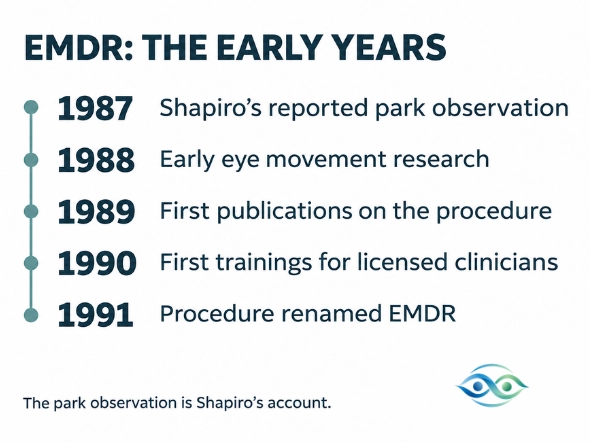
The answer depends on what counts as the start. The most common date is 1987, when Shapiro says she noticed eye movements easing her own upsetting memories. Some sources say 1988 or 1989 instead. The table below separates the milestones so the dates make sense.
Shapiro’s Own Account of the Discovery
Here is the story as Shapiro tells it. In May 1987 she was walking in a park when she noticed her upsetting thoughts fading. She connected that to the way her eyes were moving. The timing mattered. Rosen’s paper adds that she had just started looking for a dissertation topic. Her observation arrived right when she needed something to research.
She did not stop at her own experience. She tried the technique with other people. A review in Advances in Psychiatric Treatment says she worked with more than 70 people before she published her first paper two years later.
The Dispute Over EMDR’s Origins
Not everyone accepts that story. In 1995 Rosen asked six people to notice their own eye movements while walking and thinking. None could. Welch replied in 1996 that Rosen had misread how saccadic eye movements work.
The doubts did not end there. Later, Bruce Grimley and then Rosen looked at Shapiro’s own history. They pointed to her presenting herself as an expert in the eye pattern theories of neurolinguistic programming, or NLP, years before the walk. Rosen’s paper cites 1985 newspaper coverage of her NLP work through the Human Development Institute.
In 2026, Rosen and Loren Pankratz added a newly uncovered 1985 photograph. They conclude that the chance discovery story is false and that her interest came from NLP. That is their interpretation. Shapiro’s own account remains in her writing.
The 1989 Eye Movement Desensitization Study
Whatever its origin, the method needed testing. Shapiro called her original version Eye Movement Desensitization, or EMD. She tested it in a study published in April 1989 in the Journal of Traumatic Stress.

Participants and Study Design
The study enrolled 22 volunteers, aged 11 to 53. Their trauma ranged from Vietnam War experiences to childhood abuse and assault. Five of them were mental health professionals.
The volunteers were randomly split into two groups. One group received EMD. The other started with a placebo condition, where they described the memory in detail while Shapiro paused seven times to ask for a distress rating. That group then received EMD too.
Two scales tracked the results. Distress was rated from 0 to 10. A 1 to 7 scale Shapiro created measured how true a positive belief felt.
Reported Findings and Limits
Shapiro reported that distress dropped and positive beliefs strengthened in the treatment group. The placebo group showed no significant change. The effects held through a three-month follow-up.
She also named a limit herself. She was both the author and the experimenter, and the sample was small. The EMDR Institute adds that the procedure stayed experimental until independent controlled studies confirmed it.
One-Session Claims and the 1989 Case Report
The abstract says a single session desensitized the participants’ traumatic memories. That is a narrower claim than curing PTSD. The EMDR Institute says Shapiro never claimed a one-session cure. It points to a 1998 review by Lohr and colleagues as one example of that claim being wrongly attributed to her. It also says she reported an average of five sessions to treat PTSD fully. In practice, how many sessions EMDR takes can depend on how much preparation a person needs and how many memories they want to address.
A separate case report appeared that September in the Journal of Behavior Therapy and Experimental Psychiatry. It is a different paper from the controlled study. The next stage in the history of EMDR changed the method itself. Those changes came from what Shapiro saw in treatment.
From EMD to EMDR: The 1991 Name Change and Adaptive Information Processing
The 1991 Name Change
By 1991 the method had a new name. Shapiro added reprocessing and called it Eye Movement Desensitization and Reprocessing. The EMDR Institute says she had concluded the effects went beyond desensitization.
The new name reflected the insights and shifts in thinking that happened during treatment. The focus had moved past lowering distress. The Advances in Psychiatric Treatment review describes treatment that attends to the traumatic image, the negative belief attached to it and the emotional response.
Accelerated and Adaptive Information Processing
The new name came with a theory attached. The Institute says Shapiro first called it Accelerated Information Processing. She set it out in her 1995 textbook, published by Guilford Press. The Francine Shapiro Library says she felt enough studies existed by then to support EMDR as a treatment for PTSD.
The second edition in 2001 changed the first word to Adaptive, so the acronym AIP stayed the same. A third edition followed in 2018. The Adaptive Information Processing model describes how the mind may process distressing memories. It is one of several proposed explanations for how EMDR works.
Eight-Phase Structure and Alternative Stimuli
The treatment gained structure along the way. It grew into an eight-phase approach. Preparation, assessment, memory processing and follow-up are among the phases. A therapist may use resourcing during EMDR preparation to help a client practice ways to manage distress before memory processing begins.
Shapiro also published a 1994 note titled Alternative stimuli in the use of EMD(R). The title shows that stimuli beyond eye movements were already under discussion.
EMDR Training, EMDRIA, and International Growth
Teaching the method started before it even had its final name. Within a few years it had grown into a professional field.
Early Training and Restrictions
Shapiro began teaching EMDR in 1990, first to licensed mental health professionals in the United States. The EMDR Institute was created the same year. It also trained its first two university research teams, one at the University of Pennsylvania.
Outside interest was growing too. The Institute says behavior therapist Joseph Wolpe called EMD a breakthrough in 1990. He published a case report on it in 1991.
The Institute describes the early rollout as deliberately controlled. It says EMDR was still experimental at the time, because no independent controlled studies had confirmed it. So Shapiro taught only licensed clinicians and kept all training within the Institute. The Institute added restrictions in 1990 after hearing that some California trainees had taught non-licensed health workers. Clients of those workers reported negative experiences.
The restrictions did not last. The Institute says it removed them in 1995, once other controlled studies were published.
EMDRIA and Professional Standards
A professional body followed in 1995. The EMDR International Association, or EMDRIA, formed that year with 473 charter members. The Institute says it operates independently from Shapiro and the Institute and was founded to set standards for training and practice.
EMDRIA says Shapiro encouraged its development. Its stated aim is to promote high standards in EMDR practice, research and education.
International Growth and Humanitarian Work
Within a few years, EMDR had spread beyond the United States. The Institute’s timeline lists early trainings in Paris, Amsterdam, Australia, Canada, England and Germany.
Humanitarian work grew alongside it. In 1994 Institute trainers taught local clinicians in Zagreb and Sarajevo. EMDR Humanitarian Assistance Programs formed in 1995 after the Oklahoma City bombing, and the group reached Northern Ireland the same year. Wider use brought a harder question. What did the research say?
Research Scrutiny and Guideline Recognition
Early Criticism and Independent Trials
As EMDR spread, researchers asked fair questions. The first was about the early studies. They came from the person who created the method, so independent trials were needed. The EMDR The EMDR Institute dates the first randomized trial in the history of EMDR to 1993, with a veteran sample. It lists the first on civilian PTSD in 1995. It also reports that a 1998 review by the clinical psychology division of the American Psychological Association rated EMDR probably efficacious for civilian PTSD.
The second question was about the eye movements themselves. Did they matter? A 1994 study by Renfrey and Spates tested that. It split 23 people with PTSD into three groups. One received standard EMD. One followed a moving light. One kept their gaze fixed. The authors concluded the eye movements were not essential to the outcome.
Later reviews added more detail. A 2024 analysis in Psychological Medicine pooled data from eight trials with 346 patients. It found no significant difference between EMDR and other psychological treatments on PTSD outcomes. It also cites a meta-analysis that found no added benefit from the eye movements themselves. Those results are about outcomes. Theories such as AIP try to explain how the treatment works, which is a separate question. Guideline panels had to weigh all of it.
WHO, NICE, and VA/DoD Guideline Milestones
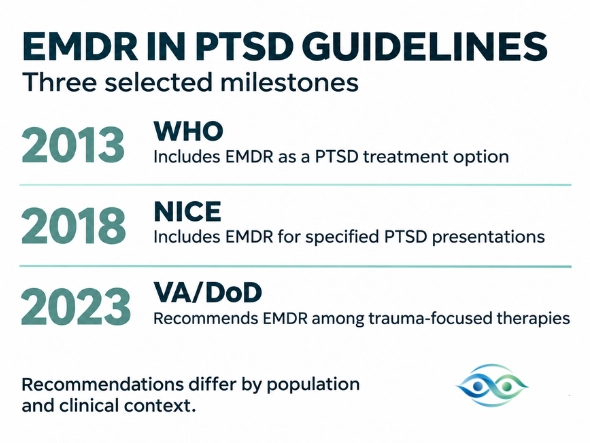
The earliest guideline here is from 2013. The World Health Organization published guidance on conditions linked to stress. It says trauma-focused CBT, EMDR or stress management should be considered for adults with PTSD. For children and adolescents it says trauma-focused CBT or EMDR should be considered. WHO wrote the guidance for non-specialist health settings.
NICE followed in 2018 with its own PTSD guideline. For adults, its main recommendation is individual trauma-focused CBT, and EMDR is the other option. One to three months after a non-combat-related trauma, NICE says to consider EMDR if the person prefers it. After three months, it says to offer EMDR. For children and young people, NICE says EMDR should be considered only if trauma-focused CBT has not worked or the child has not engaged with it.
The latest of the three came in 2023. The US Department of Veterans Affairs and Department of Defense released an updated PTSD guideline. It recommends three individual trauma-focused psychotherapies: cognitive processing therapy, prolonged exposure and EMDR. These are guideline recommendations, not regulatory approvals. They are also specific to PTSD.
Guideline Wording Compared
The three guidelines use different wording, so the table below puts them side by side.
| Guideline | Year | Population | EMDR wording | Notes |
| WHO guidelines on conditions related to stress | 2013 | Adults; children and adolescents with PTSD | Should be considered alongside trauma-focused CBT | Evidence rated moderate for adults and low for children and adolescents |
| NICE NG116 | 2018 | Adults; children and young people | Adults: consider at 1 to 3 months if preferred, offer after 3 months. Children: consider only if trauma-focused CBT has not worked | Adult recommendations cover non-combat-related trauma |
| VA/DoD PTSD guideline | 2023 | Patients with PTSD in VA and DoD care | Recommended as one of three individual trauma-focused psychotherapies | Named alongside CPT and PE |
EMDR Developments From 2010 to Today
Regional Associations and Terminology
Regional organizations kept forming. EMDR Asia formed in 2010 and the EMDR Global Alliance in 2012. Ireland founded its own association in 2020.
The way people refer to the method changed too. In 2014 Shapiro wrote an EMDRIA newsletter article asking people to say EMDR therapy instead of EMDR.
Research After Shapiro’s Death
Shapiro died on June 16, 2019. Other clinicians and researchers have carried the work forward. A 2021 review in the Journal of EMDR Practice and Research traces the history of EMDR from a desensitization technique to a broader psychotherapy approach. One example of continued development is how EMDR 2.0 adapts the standard protocol by making the tasks performed during memory recall more demanding.
Researchers have also moved into new areas. EMDRIA lists systematic reviews on EMDR for people with intellectual disabilities and for childbirth-related PTSD. A review of a new use is not the same as a guideline recommendation, and formal guideline recognition is still specific to PTSD.
Remote Delivery Since 2020
COVID-19 changed how many clinicians deliver treatment. According to the EMDR Institute, many began offering EMDR therapy over video in 2020. The Institute began offering online basic training, and EMDRIA held its first online conference.
EMDRIA lists a systematic review of remote EMDR therapy after COVID-19. The 2023 VA/DoD guideline also supports secure video delivery for therapies validated for it.

EMDR’s History at a Glance
Francine Shapiro developed EMDR, and she did it in steps. She reported her first observation in 1987. Her first published study followed in 1989, and it tested the method on 22 volunteers. In 1991 she renamed it Eye Movement Desensitization and Reprocessing, which added reprocessing to the name.
The method then spread through the 1990s. Training for licensed clinicians began in 1990. In 1994 Institute trainers taught local clinicians in Zagreb and Sarajevo. In 1995 the professional association, EMDRIA, formed with 473 charter members, and a humanitarian assistance program started after the Oklahoma City bombing.
Two threads run through that history. The first is documented. Randomized trials began in 1993. EMDR appears in WHO’s 2013, NICE’s 2018 and VA/DoD’s 2023 PTSD guidance. These dates and guideline wordings are on record, and they apply to PTSD only.
The second thread is contested. Researchers disagree about where the idea came from. Shapiro says it began with a walk in a park in 1987. Rosen and Pankratz concluded in 2026 that her interest came from neurolinguistic programming. Researchers also disagree about how the treatment works. A 1994 study concluded the eye movements were not essential to the outcome. AIP, the model Shapiro set out in 1995, is one explanation among several.
Frequently Asked Questions
What Was the EMDR Network?
The EMDR Network formed in 1991, according to the EMDR Institute. It published the EMDR Networker, which the Institute describes as the first publication focused on EMDR clinical issues. It also held the first EMDR conference in San Jose, California, in 1992. EMDRIA replaced it in 1995.
When Was EMDR Europe Founded?
EMDR Europe formed in 1999, based on the EMDR Institute’s timeline. EMDRIA Latinoamerica formed the same year.
Who Developed the Butterfly Hug Used in EMDR?
The Butterfly Hug is a self-administered method of bilateral stimulation. Lucina Artigas originated it while working with survivors of Hurricane Pauline in Acapulco, Mexico. Sources differ on the year. The EMDR Institute lists 1997, while a 2021 paper by Ignacio Jarero and Artigas says 1998.
When Did EMDR Get Its Own Research Journal?
The Journal of EMDR Practice and Research launched in 2007, per the EMDR Institute. EMDRIA calls it its official publication. It publishes peer-reviewed papers on EMDR therapy.
Conclusion
The history of EMDR is a story about scrutiny. Shapiro named the limits of her own 1989 study, which had 22 volunteers and one researcher running it. Other researchers then spent decades testing the method in controlled trials and reviews.
That testing is why WHO, NICE and VA/DoD list EMDR in their PTSD guidelines today. The origin story has its doubters, and the mechanism is still debated. Neither point changes what the trials found, and that record is what a therapy is judged on.