

Some memories stay vivid long after the event is over. They replay in sharp detail, and the distress feels as fresh as the day it happened. EMDR was first developed to help people process distressing memories. In 2020, two psychologists presented an adapted version of it to clinicians. So what is EMDR 2.0, and how does it change the therapy?
The name alone doesn’t answer that, and the details are easier to follow step by step. In this article, you’ll learn how it works and how it compares with standard EMDR. We’ll also look at what a session involves and what the research shows so far.
Key Takeaways
- EMDR 2.0 showed no emotionality or vividness advantage over standard EMDR (62 non-PTSD people, 2021).
- A 2021 one-session trial found EMDR 2.0 needed fewer sets than EMDR (62 non-PTSD people).
- The ISRCTN entry for ENHANCE, a 130-patient EMDR 2.0 PTSD trial, lists no results.
- Online group EMDR 2.0 beat stress management on anxiety (about 25 traffic-accident survivors, 2025).
- ENHANCE’s 2023 protocol cites studies where 5% to 64% still met PTSD criteria after EMDR.
What Is EMDR 2.0?
EMDR 2.0 is an adaptation of eye movement desensitization and reprocessing (EMDR), a therapy for distressing and traumatic memories. Psychologists Suzy Matthijssen and Ad de Jongh developed it to reduce the distress and vividness of a target memory more efficiently. It keeps the eight-phase structure of standard EMDR.
Matthijssen and de Jongh saw room to improve. In a 2023 trial protocol in Frontiers in Psychiatry, they and their colleagues cite controlled studies in which 5% to 64% of patients still met PTSD criteria after EMDR, and 18% dropped out before finishing. The pair first presented the adapted approach to clinicians in 2020. The 2.0 label refers to a change in how therapy is delivered, and no new device or app is involved.
Answering what is EMDR 2.0 properly means starting with how working memory behaves under load.
How Does EMDR 2.0 Work?
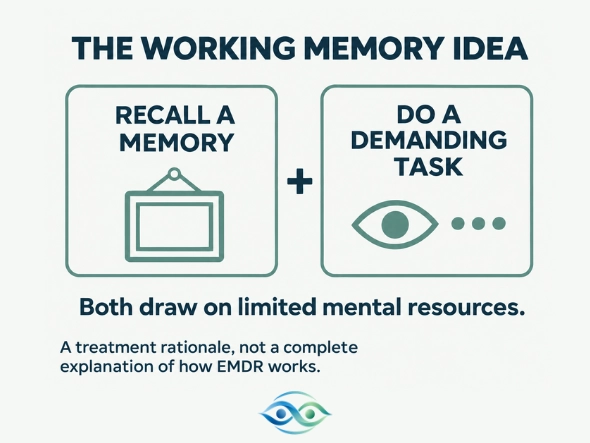
Working memory is the mental workspace you use to hold something in mind while you work with it. Its capacity is small. Try repeating a phone number while counting backward by sevens, and both tasks get harder.
The same competition happens when someone recalls a distressing memory while doing a demanding task. Attention splits, and the memory loses some of its vividness and emotional charge. Standard EMDR already works this way, because following a therapist’s moving hand is itself a working memory task. The authors of that Frontiers in Psychiatry protocol rate working memory theory as having the strongest evidence among the explanations proposed for how EMDR works.
Matthijssen and de Jongh asked whether a heavier load would help more. Their approach aims for stronger memory activation, more arousal, an element of surprise, and tasks matched to the sensory quality of the memory, such as an auditory task for a memory built around a sound. That last idea, called modality-specific taxation, has the weakest footing. The same protocol describes its evidence as limited and contradictory.
In that protocol, Matthijssen and de Jongh also point to reconsolidation. The theory says a recalled memory stays flexible for a short time before it is saved again. If a demanding task competes with it during that time, the version that gets saved may be less distressing. This part remains a proposal.
What Is the Difference Between EMDR and EMDR 2.0?
The two versions share a foundation. Both follow the eight-phase structure and ask the client to hold a target memory in mind while doing a task. Eye movements, often called bilateral stimulation, appear in each, and both work through working memory. Standard EMDR is usually explained through the Adaptive Information Processing model.
What changes in practice is how deliberately the therapist builds memory activation and task load. Practice also varies within standard EMDR, so the table shows typical emphasis for each approach.
| Feature | Standard EMDR | EMDR 2.0 |
| Motivation | Treatment rationale given during preparation | Explicit focus on the client’s role in keeping the memory active |
| Memory activation | Image, belief, emotion and body sensation identified | Same elements, with added attention to sensory detail |
| Working memory task | Usually eye movements | Eye movements plus counting, spelling or tapping, often combined |
| Task adjustment | Varies by practitioner | Therapist raises or lowers task and sensory demand as processing changes |
| Evidence base | Recommended first-line PTSD treatment | Early evidence; PTSD trial still pending |
The first four rows are changes a client can notice in session. To see how they fit together, follow a session in order.
What Does the EMDR 2.0 Protocol Involve?
The word protocol gets used in two ways. In research papers, it means the plan for a clinical trial. In training courses, it means the script therapists follow. What follows is an overview of how treatment unfolds, and it leaves the script out.
Motivation and Memory Activation
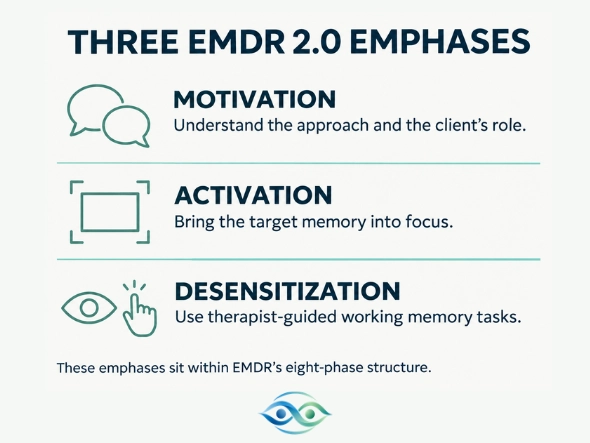
According to a 2024 case report in Frontiers in Psychiatry, EMDR 2.0 has three main elements: motivation, activation, and desensitization. Motivation comes first, and the therapist explains why holding the memory in mind matters and what role the client plays in keeping it active. That builds collaboration and reduces avoidance, the pull to steer away from the memory.
Activation follows. The client identifies the target image, the beliefs that go with it, the emotions and body sensations it brings up, and how distressing it feels now. Sensory detail helps keep the memory active once the tasks begin. Slow progress says more about the memory’s grip than the client’s effort.
Desensitization With Working Memory Tasks
With the memory active, the therapist adds a task. Eye movements are one option, often faster or varied. Others include counting, spelling, or tapping a pattern while doing something else. The therapist picks the task and adjusts it during the session.
A task that feels too easy gets harder, and one that pulls the client away from the memory entirely gets simpler. A task can also match the memory’s main sense, which is the modality idea from earlier. The task is meant to occupy the mind, and it does not ask the client to endure more distress than they can handle.
After a short set, the therapist pauses, asks what has changed, and checks how distressing the target feels. Processing continues until the distress eases. Later steps strengthen a positive belief and check for body sensations. Easing one memory does not mean treatment is finished, since it can cover several targets. Training also covers titration, flashforwards, and the EMD bomb.
Is EMDR 2.0 More Effective or Faster?
Not yet shown. The evidence so far does not show EMDR 2.0 outperforming standard EMDR, and the trial built to test that in people with PTSD lists a protocol but no results on its ISRCTN registry entry.
Questions about what is EMDR 2.0 and how fast it works get muddy because faster can mean three different things. Effectiveness is how far distress falls. Efficiency is how many sets it takes to get there. Duration is how many sessions and weeks treatment lasts. The research so far touches only the second.
The 2021 Single-Session Comparison
The main head-to-head test is a 2021 study in the European Journal of Psychotraumatology. It randomly assigned 62 people without a PTSD diagnosis (79% women, average age 35) to a single session of EMDR or EMDR 2.0 on one disturbing memory. Ratings came before the session, right after, and at one and four weeks. Emotionality, vividness, and session time did not differ between the groups. The EMDR 2.0 group did need fewer sets, which the authors defined as about 30 seconds of working memory taxation. They called the efficiency claim partially supported.
That result is narrower than it first sounds. Fewer sets does not mean fewer treatment sessions, and finding no difference is not proof that the two approaches are equal. It was a single session in people without PTSD, led by the developers and funded by the Dutch EMDR association, according to VU Amsterdam’s research portal.
The 2025 Group Trial and Combined Treatment
A 2025 trial in Frontiers in Psychiatry tested an online EMDR 2.0 group protocol in people who had been in traffic accidents. Against a stress-management module, the EMDR 2.0 group improved on anxiety, stress, avoidance, and hyperarousal scores. Depression and intrusion scores did not differ, although an earlier pilot of seven people had reported lower depression.
The trial illustrates how EMDR can be delivered remotely in a group setting. Its findings apply to that setting, and the study leaves outcomes for individual online sessions open. The sample was about 25 people in a nonclinical group, and the trial compared EMDR 2.0 with stress management, leaving the comparison with standard EMDR unresolved. The authors were independent of the earlier development work.
The 2024 case report also followed one patient who reached remission after an intensive online program that combined prolonged exposure, exercise, EMDR 2.0, and psychoeducation. With several treatments running together, the outcome cannot be credited to EMDR 2.0 alone.
The ENHANCE Trial
ENHANCE is the first randomized trial to test EMDR 2.0 in people diagnosed with PTSD, according to its protocol in Frontiers in Psychiatry. Its design assigns 130 patients with PTSD or complex PTSD at random to standard EMDR, EMDR 2.0, or the Flash technique, a separate newer method.
The ISRCTN registry entry adds that each group gets six weekly 60-minute sessions after a 90-minute case conceptualization, with follow-up at 12 weeks. Until its results are published, any answer to what is EMDR 2.0 and whether it is faster or better rests on expectation.
Who Is EMDR 2.0 For, and What Does Starting Look Like?
Suitability is decided in assessment, and a diagnosis alone does not settle it. A therapist might reach for these adjustments when processing stalls and distress ratings stop falling. Complex PTSD is one of the groups ENHANCE is testing, which keeps it an open question.
Before treatment begins, the therapist asks about goals, current safety, any tendency to dissociate, how emotions show up, and whether the client can stay engaged during processing. Pacing techniques such as titration let the therapist slow down when emotions run high.
What Starting Looks Like
The first sessions cover how the approach works, informed consent, and a signal for pausing. If you’re preparing for your first EMDR session, write down any questions about what the tasks involve or how to ask for a pause. From there, the client sets the pace and says when a task feels wrong.
Some temporary emotional activation or tiredness can follow a session. That description comes from trauma-focused therapy in general and does not reflect an EMDR 2.0 measurement. Each session ends with closure and a plan for support between sessions.

Conclusion
EMDR 2.0 keeps standard EMDR’s eight phases and changes how the therapist sets and adjusts the task. That is a change in method, and the research behind it is still early. Fewer sets in one session is a start, but it does not yet show better PTSD outcomes.
So what is EMDR 2.0? It is an adaptation with a clear rationale and an evidence base still under construction. The ENHANCE trial is the study to watch, since it tests EMDR 2.0 in people diagnosed with PTSD. If you are considering it, a therapist can assess whether it fits your situation.