

If you’ve been reading about EMDR, you’ve probably noticed that therapy doesn’t open with the hardest memories. Before that comes a preparation stage, and one word keeps turning up in it: resourcing. So what is resourcing in EMDR, and why do therapists start there? It’s a fair thing to wonder about if you’re considering therapy yourself.
Knowing the basics can make that first conversation with a therapist feel a lot less uncertain. In this article, you’ll learn how a session works, which exercises are common, and what helps when one doesn’t. We’ll also look at how long preparation takes and what the research says.
Key Takeaways
- Hornsveld’s 2011 study of 53 undergraduates found EMDR-style eye movements made positive memories less vivid.
- 13 of 15 healthy volunteers saw no resource strength difference with tactile stimulation (Amano, 2016).
- Hornsveld’s 2012 rejoinder urged stopping eye movements in EMDR resource installation until proven helpful.
- Amano’s 2016 study found 12 of 15 healthy volunteers favored tactile stimulation for relaxation.
- Korn’s 2002 proposal of EMDR resource installation for complex PTSD included two preliminary case reports.
What Is Resourcing in EMDR?
Resourcing is the part of EMDR therapy that builds on a client’s existing strengths, supportive experiences and coping skills, so the client can steady themselves during treatment.
It takes place mainly in Phase 2, Preparation, and draws on the stabilizing resources, or steadying tools, that EMDRIA’s example case form lists:
- A Safe/Calm Place the client imagines
- A Container for distressing material
- Resource Development and Installation (RDI), a structured way to strengthen a resource
- Skills to stay present
EMDR therapy moves through eight phases, from history taking to reevaluation. Resourcing starts before Phase 2, because the therapist already assesses a client’s internal and external resources during history taking in Phase 1. It also returns later in treatment when needed.
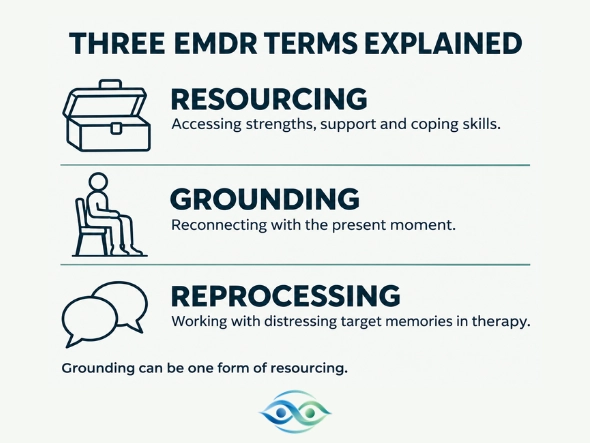
Resourcing sits close to two other terms, which makes the three easy to blur. Resourcing means accessing support, steadiness or capability. Grounding means reconnecting with the present, and it is one possible resource. Reprocessing means working with distressing target memories, the memories chosen for treatment. The Adaptive Information Processing model behind EMDR helps explain why treatment focuses on these memories. Resourcing prepares a person for that work, so the practical question is what it teaches a person to do.
Why Is Resourcing Used in EMDR?
Resourcing builds four skills. The first is recognizing changes in emotional and physical activation. The second is staying aware of the therapy room while approaching difficult material. The third is communicating discomfort with a stop signal, an agreed hand raise or word set up in Phase 2. The fourth is accessing calm, confidence, connection or support.
Together, these skills keep a person inside the window of tolerance, the range of arousal in which someone can feel, think and take things in. Daniel Siegel introduced the term in his 1999 book The Developing Mind, reviewed in the American Journal of Psychiatry. It comes from the wider trauma field and is not specific to EMDR.
Preparation aims for tolerable distress and active participation. Perfect calm is not required. These benefits are intended, not proven. Research on resourcing procedures on their own is thinner than for full EMDR treatment, and evidence for the full treatment does not transfer to individual exercises. Each skill gets built one at a time, in session.
What Happens During an EMDR Resourcing Session?
A therapist guides the work in sequence. First, the therapist and client identify the quality or coping ability the client needs. The client then selects a personally meaningful resource and explores the thoughts, sensations, images and sensory details tied to it.
Together they check for helpful responses and unwanted associations. The client practises accessing the resource, perhaps with a short cue word. Last comes a test against a mildly irritating thought or a small recent stressor, with the therapist guiding.
A therapist can guide resourcing in person or during live video EMDR sessions. For video visits, the therapist and client can agree beforehand on how to signal a pause and what to do if the call drops.
Resource Development and Installation
RDI is a structured resourcing procedure, described by Korn and Leeds in 2002. Broader resourcing also includes simpler coping practices. RDI installs a resource in Phase 2, while Phase 5 installation strengthens a positive belief tied to a target memory.
Bilateral Stimulation in Resourcing
Some EMDR resourcing techniques add bilateral stimulation: brief alternating movements, taps or sounds, in short sets and slower than in reprocessing. It is optional, and the therapist monitors the client’s response and adjusts.
Research on Bilateral Stimulation in RDI
Korn and Leeds proposed RDI for stabilizing complex PTSD, a severe form of PTSD that adds trouble with emotions and relationships, citing two preliminary case reports. Hornsveld and colleagues (2011) had 53 undergraduates recall three positive memories, and eye movements lowered vividness, pleasantness and the felt strength of the quality. Leeds and Korn (2012) answered that the study overstated its relevance to RDI and proposed testing patients with measured coping difficulties, with and without eye movements. Hornsveld, de Jongh and ten Broeke (2012) urged a stop to eye movements in RDI and safe place work until their added value is shown.
In Amano and Toichi (2016), 15 healthy volunteers rated brief recall trials with and without tactile stimulation. Ten favored it for accessibility, 12 for relaxation, and 13 saw no difference in resource strength. The sample was small, and tactile stimulation was not compared with eye movements. Both studies used people not in treatment, so whether bilateral stimulation helps the clients resourcing is meant for remains open. Either way, the sequence ends with the resource holding up under the test.
How Are EMDR Resourcing Scripts Used?
Resourcing scripts are prompts that guide attention and check responses. Standardized clinical procedures differ from personal reminders, and formal RDI scripts are written for clinicians who have completed approved EMDR basic training.
A simple prompt shows the idea: “Which moment stands out when you felt steady, and what do you notice in your body as you recall it?”
Common EMDR Resourcing Exercises and Techniques
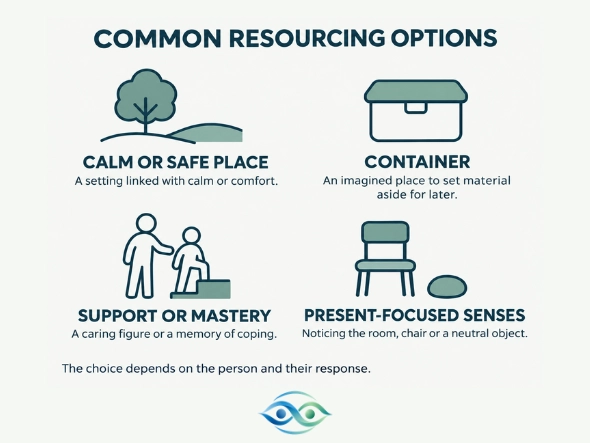
That sequence tends to produce a few recurring types of resource. Four are common in preparation.
Calm or Safe Place
A Calm or Safe Place is a real or imagined setting tied to calm or comfort. The client adds personally meaningful sensory details, like sounds and smells. A cue word, a word or phrase chosen with the therapist, represents the resource and can bring the state back.
The label can change to calm, comfortable or whatever fits, because the word safe can feel loaded to some people. No such exercise promises complete safety or instant relaxation.
Container Exercise
The Container exercise gives distressing material an imagined place to wait, such as a lockbox or a sealed jar. The client chooses when to return to those thoughts or feelings, and the therapist plans that later attention with them. It pauses distress for a planned return, which separates it from avoidance. It does not erase a memory or suppress it for good.
Nurturing and Protective Figures, and Mastery Memories
Figures carry care, protection, guidance or connection. Nurturing and protective figures are the usual pair, and some programs add a wise figure. A figure can be real or imagined, depending on how the client responds to it.
What is resourcing in EMDR when no figure fits? Recalling a time of caring for a pet, a plant or another person can stand in.Mastery memories hold experiences of coping, persistence or competence. Ordinary achievements count. Mixed associations with either type can change the choice.
Present-Focused Sensory Resources
Present-focused sensory resources keep attention on what is here now: details of the room, the contact of the chair against the back, or a neutral object held in the hand. Comfortable breathing can help when it feels easy. No breathing count is imposed, and inward attention is not assumed to suit everyone.

Comparing the Exercises and Other Resources
| Exercise | Main purpose | What it involves | Adaptation to consider |
| Calm or safe place | Gives a rehearsed route back toward steadiness | Choosing a setting, then rehearsing sensory details | Sounds or words if imagery is limited |
| Container | Makes room to pace difficult material | Imagining a holder, choosing what goes in | Return to the present if distress rises |
| Nurturing and protective figures, mastery memories | Brings felt support or capability into session | Recalling a caring figure or ordinary achievement | Switch to another experience if associations mix |
| Present-focused sensory resources | Anchors attention in the current surroundings | Naming room details, feeling the chair | External attention if breathing feels uncomfortable |
Other resources in use include the light stream, the Inner Advisor and Constant Installation of Present Orientation and Safety (CIPOS).
What If a Resourcing Exercise Does Not Help?
Some people say “I can’t find a safe place” or “it doesn’t feel real” when they try a resourcing exercise. Each points to an adjustment.
Limited Imagery and Difficulty With Positive Feelings
When visualizing is hard, including aphantasia, where mental images do not form, a resource can rest on sounds, words, movement or the present surroundings. When calm or good feelings themselves feel unsafe, the therapist can try another resource or a less emotionally loaded focus.
What is resourcing in EMDR for people who struggle to tolerate positive feelings, such as survivors of early emotional neglect?A 2022 paper by Leeds in the Journal of EMDR Practice and Research describes a Preparation phase protocol for them. It is called Positive Affect Tolerance and Integration, and it targets tolerating appreciation, praise and affection.

Mixed Associations, Body Discomfort and Rising Distress
Mixed associations call for another experience linked to the same quality, or another resource. Breath or body discomfort calls for a shift to external sensory attention. Rising distress or disconnection calls for the stop signal and a therapist-supported return to the present.
Treating Difficulty as Information
What counts is the client’s honest report, with no pressure to describe improvement. A suitable resource steadies the person, and one that merely sounds positive may not. Difficulty is information about fit.
It does not mean the client has failed or that EMDR cannot help. A therapist can work with numbness or disconnection once the client reports it. When a resource does hold, the client can reach it on cue and stay steady with a mild stressor in mind.
How Long Does EMDR Resourcing Take, and When Is It Enough?
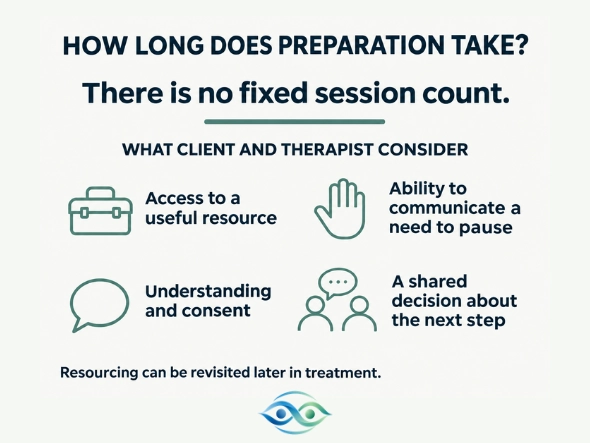
The time spent on resourcing varies by client and is one factor in how long EMDR therapy takes overall. Therapists watch for signs of readiness before moving on. One sign is that the client can steady themselves with a resource, even with a mildly irritating thought in mind. Another is that the client can use the stop signal. The client also understands the risks of reprocessing and consents to it, and client and therapist agree it is time to move on.
Preparation length is an open debate among clinicians. Many lengthen it for complex trauma, following the phase-based model, which puts stabilization first. A 2019 review by de Jongh and colleagues found little empirical evidence that stabilization must precede trauma processing in complex PTSD, though some patients may need resource installation.
The decision sits with the treating therapist. Therapists can also return to resourcing in later phases when needed. The same resources get practised outside sessions.
Practising Resourcing Between Sessions
Between sessions, practice builds EMDR resourcing skills using resources the client has already explored and agreed on with the therapist. Therapists often suggest brief practice during manageable moments, without set daily schedules. A personalized written cue or recording can help, with the client’s consent.
Clients can note how useful a resource felt, any unwanted reactions and questions for the next session.

If Practice Raises Distress
If practice raises distress, the client follows the response agreed with the therapist beforehand. Practice covers resources only and excludes reprocessing traumatic memories independently.
Self-Tapping and the Butterfly Hug
Where a therapist has approved self-tapping, one option is the Butterfly Hug, described by Lucina Artigas and Ignacio Jarero: crossed arms and alternating taps below the collarbones. Given the unsettled evidence on bilateral stimulation, it is no proven booster.
Conclusion
So, what is resourcing in EMDR? It’s the groundwork that helps a person stay steady when therapy turns to difficult material. It starts with strengths and supports the client already has, and it adjusts when an exercise doesn’t fit.
Still, the evidence for individual exercises, bilateral stimulation included, remains thin. That is why pacing and readiness stay with the treating therapist. If you’re getting ready for your first EMDR appointment, write down any questions you have about which resources might fit you and how the therapist will pace the preparation phase. Bring those questions to your first conversation.